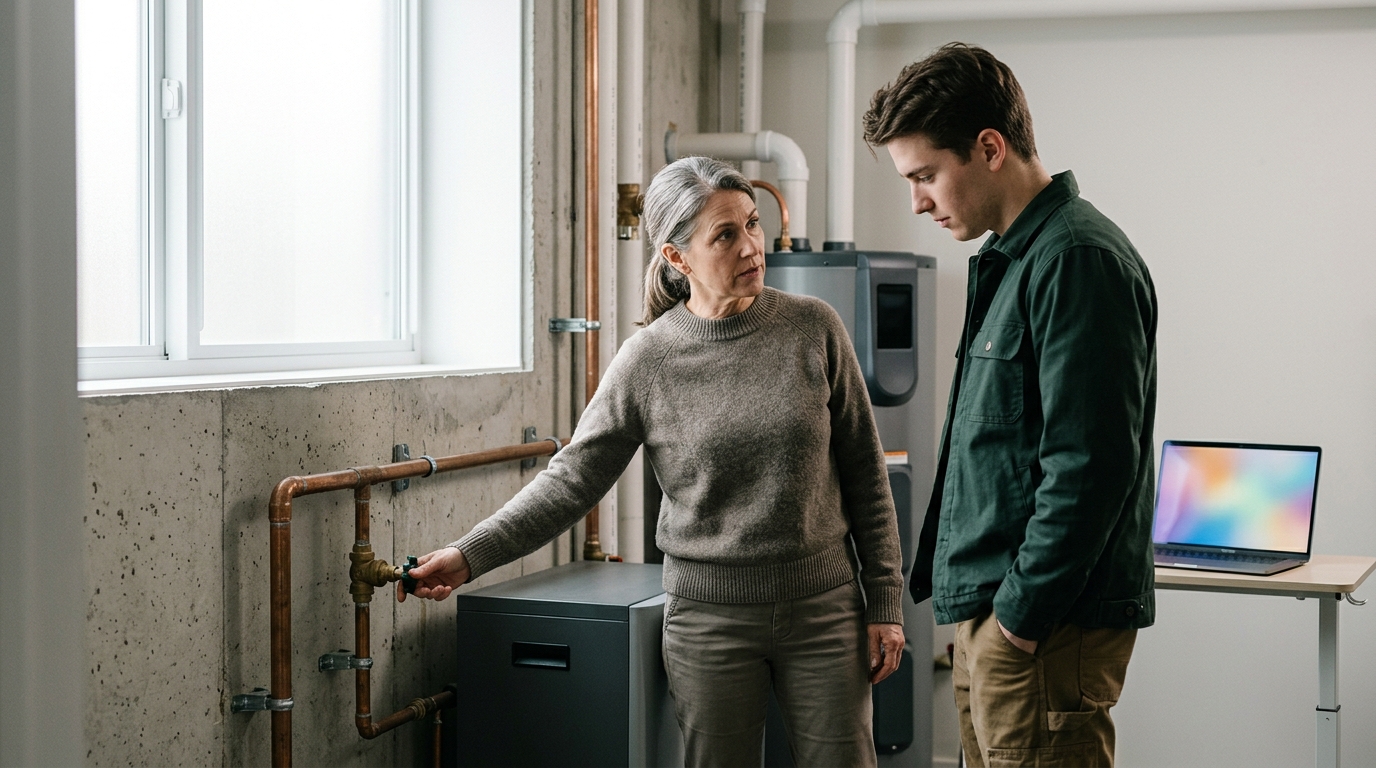
It's 2:17am. You hear a hiss, then a rush. You stumble downstairs and there's an inch of water on the basement floor. What you do in the next ninety seconds is the entire ballgame.
In Denver-metro homes we visit, the difference between a $400 repair and a $15,000 mold-remediation job is almost always how fast the homeowner got the water off. Here's how to be that homeowner.
1. Find your main shutoff today. Not tonight.
In a Colorado home built after 1985, the main is almost always inside the house, in one of three places:
- Basement, near the front of the house- typically on the wall closest to the street, often near the water meter.
- Mechanical/utility room- next to the furnace or water heater. Look for a ball valve (lever handle) or gate valve (round handle).
- Crawl-space access- for slab-on-grade or pier-and-beam, the valve might be just inside the crawl door.
Pro move: Tape a printout of the valve location + a photo inside your breaker-panel door. The person who needs it most will be panicking. Don't make them search.
2. Know which way to turn it.
Ball valves (lever): perpendicular to the pipe = OFF. Gate valves (round): clockwise = OFF, and they may need 6-8 full turns. Don't force a stuck valve - see step 4.
3. If you can't reach the main, isolate the fixture.
Most fixtures have a local shutoff: angle stops under sinks and toilets, a labeled valve at the water heater inlet, a hose-bib for outdoor leaks. Turning one of those off buys you time to get to the main.
4. If the valve is seized, call us - and call your water provider.
Older gate valves seize. If you can't turn it, don't lean on it. Denver Water (and Aurora Water, Centennial Water, etc.) can shut off the curb stop at the property line. Call them at the same time you call us - we'll meet you there.
5. Replace the gate valve before it betrays you.
If your main shutoff is a 1970s-era gate valve, replace it with a quarter-turn ball valve while the situation is calm. We charge $185-$295 for the swap depending on access. Cheapest insurance you'll buy.