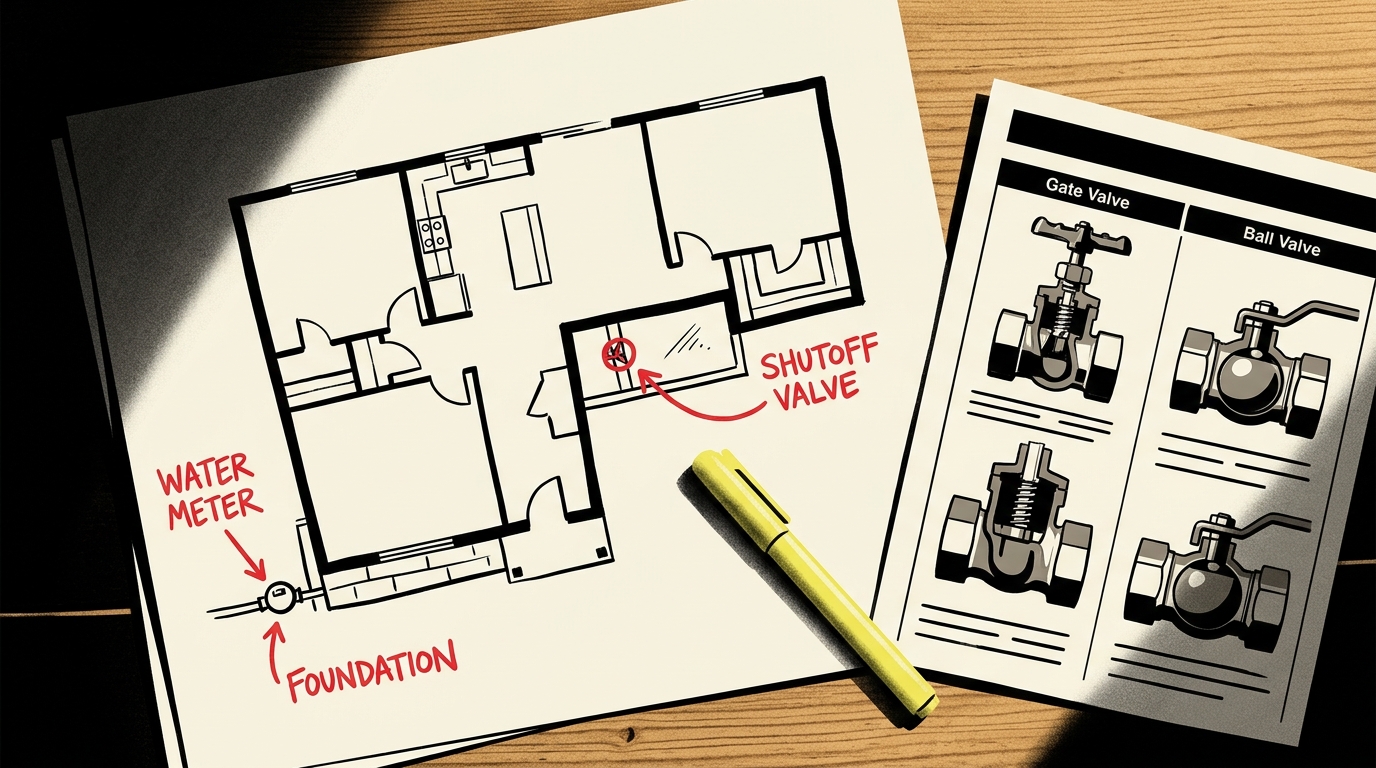
To shut off your home's water supply in an emergency, locate your main shutoff valve - typically found near the water meter, in a basement, crawl space, or utility room - and turn it clockwise (righty-tighty) until it stops. This takes 10–30 seconds and immediately halts water flow to the entire house.
A burst pipe, failed washing machine hose, or flooding water heater can dump hundreds of gallons into your home within minutes. Knowing exactly where your shutoff valves are and how to operate them is the single most effective action you can take to limit water damage. This guide walks you through every type of shutoff valve, where to find them, and what to do immediately after you've stopped the flow.
Types of Home Water Shutoff Valves
There are two main types of main shutoff valves in residential plumbing. Knowing which one you have saves critical seconds in a crisis.
- Gate valve: An older, round wheel-shaped handle. Requires multiple full rotations clockwise to close completely. Common in homes built before the 1990s. These can seize up if unused for years - test yours annually.
- Ball valve: A lever-style handle. Requires only a quarter-turn (90 degrees) clockwise to shut off completely. The lever runs parallel to the pipe when open; perpendicular when closed. Standard in modern construction and far more reliable in emergencies.
Where to Find Your Main Shutoff Valve
Your main shutoff valve is almost always located within 3–5 feet of where the water supply line enters your home. Check these locations in this order:
- Basement or crawl space: Look along the front foundation wall, closest to the street. This is the most common location in colder climates.
- Utility room or mechanical room: Near the water heater or furnace, especially in slab-foundation homes.
- Under a kitchen or bathroom sink: Less common for the main valve, but possible in some older townhomes and condos.
- Outside near the water meter: In warmer climates (Southern U.S., California, Arizona), the main shutoff is often in a covered box flush with the ground near the curb or property line. This box is sometimes called a "buffalo box" or meter pit.
- Garage wall: Common in ranch-style homes in mild-weather regions.
If you genuinely cannot find your main shutoff, call your water utility's emergency line - they can shut off supply at the street meter. Most utilities operate 24/7 emergency lines for exactly this scenario.
Step-by-Step: Shutting Off the Main Water Supply
- Stay calm and move fast. Every second counts with active flooding. Grab a flashlight if the valve is in a dark area.
- Locate the main shutoff valve using the locations listed above. If you've never found it, do this exercise right now - before any emergency happens.
- Turn the valve clockwise. For a ball valve, rotate the lever 90 degrees until it's perpendicular to the pipe. For a gate valve, turn the wheel clockwise until it won't turn further. Don't force it - if a gate valve is seized, use an adjustable wrench for extra torque.
- Verify the water is off. Open a faucet on the highest floor of your home. If water flows for a few seconds and then stops, the valve is working. If it keeps running, the valve may not be fully sealing - proceed to the street meter shutoff.
- Turn off your water heater. Once the main supply is off, immediately switch your water heater to "pilot" mode (gas) or shut off the circuit breaker (electric). Running a water heater without water supply can damage the heating element or cause dangerous pressure buildup.
- Open a faucet to relieve pressure. Open a ground-floor faucet to drain remaining water from the pipes, which reduces pressure and limits further leakage.
- Address the source of the emergency and call a licensed plumber.
Shutting Off Water at the Street Meter
If your main indoor valve fails or is inaccessible, go directly to the street meter. Here's how:
- Find the meter box - a concrete or plastic cover flush with the ground, usually near the curb or sidewalk in front of your home.
- Use a flathead screwdriver or meter key to open the lid. Meter keys are available at hardware stores for under $20 and are worth keeping on hand.
- Inside, you'll see the meter and a shutoff valve on the house side of the meter. Turn it clockwise with a wrench or meter key until fully closed.
- Important: In some municipalities, the street-side valve is utility property and you are legally restricted from operating it. In that case, call your utility's emergency line and they will respond - typically within 30–60 minutes.
Individual Fixture Shutoff Valves: Stop the Problem at the Source
If only one fixture is involved - a toilet overflow, a leaking sink supply line - use the individual shutoff valve instead of cutting water to the whole house. This minimizes disruption while you deal with the problem.
- Toilets: Look behind and below the toilet tank for a small oval or football-shaped knob on the supply line. Turn it clockwise.
- Sinks: Open the cabinet under the sink. Two valves on the wall or floor (one hot, one cold) control that fixture.
- Washing machine: Two valves (hot and cold) are located directly behind the machine on the wall. Turn both clockwise. Many plumbers recommend keeping these valves closed when the machine is not in use - a common cause of major home flooding is a washing machine supply hose burst.
- Water heater: A single cold-water supply valve sits on the pipe entering the top of the tank. Close it to isolate the heater.
- Refrigerator ice maker: A small saddle valve is typically located on the cold water supply line under the kitchen sink or behind the fridge.
Main Shutoff Valve vs. Individual Fixture Shutoff: Quick Comparison
Feature
Main Shutoff Valve
Individual Fixture Valve
Scope
Entire home
Single appliance or fixture
Best used when
Source is unknown or multiple failures
Single fixture is clearly the problem
Disruption to household
High - no water anywhere
Low - rest of home unaffected
Tool required
Sometimes a wrench (gate valve)
Usually by hand
Speed of operation
10–30 seconds (ball valve)
5–10 seconds
Prepare Before an Emergency Happens
The worst time to find your shutoff valve is while water is spraying across your kitchen. Do these four things today:
- Locate and label your main shutoff valve. Put a bright tag or a piece of colored tape on it so every adult and older child in the household can find it in seconds.
- Test the valve annually. Turn it off and back on once a year to prevent gate valves from seizing. If a gate valve no longer closes fully, have a plumber replace it with a ball valve - the cost is typically $150–$350 depending on accessibility.
- Keep a meter key accessible. Store one near your main valve or in a toolbox. They cost under $20 at any hardware store.
- Know your utility's emergency number. Save it in your phone contacts right now. You can find it on your water bill or your municipal utility's website.
After You've Shut Off the Water
Once the immediate crisis is contained, take these steps in order:
- Document the damage with photos and video immediately - your homeowner's insurance claim depends on this.
- Call a licensed plumber. In cases of major flooding, call a water damage restoration company simultaneously - fast drying in the first 24–48 hours dramatically reduces mold risk.
- Notify your homeowner's or renter's insurance carrier as soon as possible. Most policies have reporting time requirements.
- Do not restore water supply until the breach is repaired and inspected.
Where is the main water shutoff valve in most homes?
In most U.S. homes, the main water shutoff valve is located in the basement or crawl space along the front foundation wall, within 3–5 feet of where the supply line enters the building. In slab-foundation or warm-climate homes, it's often in a utility room, garage, or an outdoor meter box near the curb.
Which direction do you turn a water shutoff valve to close it?
Turn any water shutoff valve clockwise to close it - remember "righty-tighty." For a ball valve, rotate the lever 90 degrees clockwise so it sits perpendicular to the pipe. For a gate valve, keep turning clockwise until the wheel stops moving.
What if my main shutoff valve won't turn or is stuck?
Apply an adjustable wrench or channel-lock pliers for additional torque on a stuck gate valve. Never force it beyond resistance - you can crack the valve body. If it won't budge, go directly to the street meter shutoff or call your water utility's 24/7 emergency line to shut off supply at the street.
Should I shut off my water heater when I turn off the main supply?
Yes, always. Shut off a gas water heater by switching it to "pilot" mode. Turn off an electric water heater at the circuit breaker. Running a water heater without an incoming water supply can burn out the heating element or cause dangerous pressure buildup in the tank.
How long does it take to shut off water in an emergency?
With a ball valve in a known, accessible location, shutting off the entire home's water supply takes under 30 seconds. Locating a gate valve in a dark basement and turning it fully closed can take 1–3 minutes. Locating the street meter and operating it with a tool can take 3–10 minutes. This is why locating and labeling your valve in advance is critical.