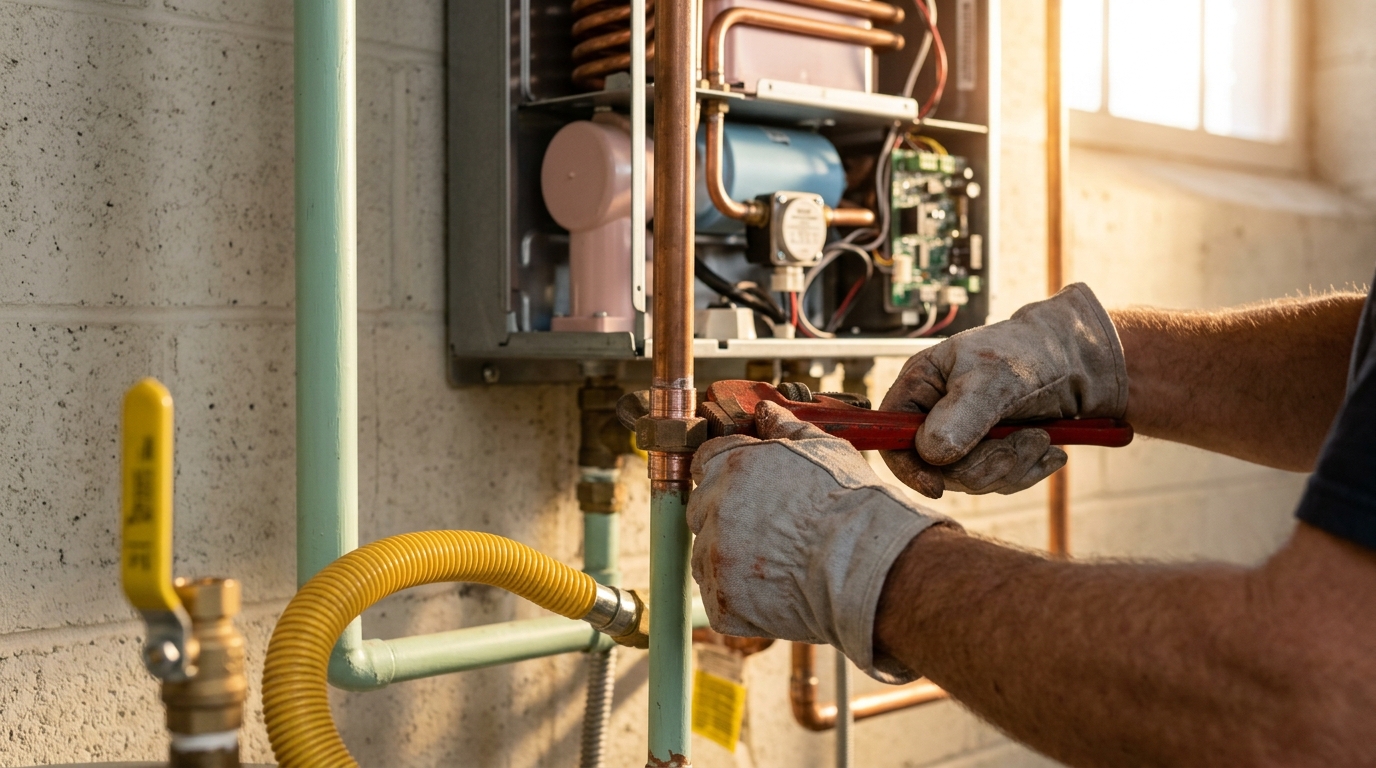
Tankless water heaters deliver hot water on demand and can cut water heating energy costs by 24–34% compared to traditional storage-tank units in homes that use 41 gallons or fewer of hot water daily, according to U.S. Department of Energy data. That efficiency advantage is real, but it comes with higher upfront costs and installation complexity that make the traditional tank the right choice for many households. Here is everything you need to know to make the right call for your home.
How Each System Works
Traditional tank water heaters store 20–80 gallons of water in an insulated tank and keep it hot around the clock using a gas burner or electric heating element. Hot water is available immediately when you open a tap, but the unit constantly burns energy to maintain temperature - a phenomenon called standby heat loss.
Tankless (on-demand) water heaters have no storage tank. When you turn on a hot-water tap, cold water travels through a pipe and is heated instantly by a gas burner or electric element. The unit shuts off the moment you close the tap. You never run out of hot water as long as demand stays within the unit's flow-rate capacity, but you also pay a steep premium to get that system installed.
Side-by-Side Comparison: Tankless vs. Traditional Tank
Factor
Tankless
Traditional Tank
Unit purchase price
$500–$2,000+
$300–$900
Installation cost
$800–$2,500
$200–$700
Lifespan
20+ years
8–12 years
Energy efficiency
Up to 34% more efficient
Baseline
Hot water supply
Unlimited (within flow rate)
Limited to tank capacity
Space required
Compact (wall-mounted)
Large footprint (floor-standing)
Standby heat loss
None
Continuous
Risk of running cold
Low (but possible at peak demand)
Yes, tank depletion is common
Flood damage risk
Minimal (no stored water)
High (40–80 gallons on site)
Upfront Cost and Installation
The total installed cost of a gas tankless unit typically runs $1,300–$4,500, depending on brand, capacity, and whether new gas lines or upgraded electrical panels are required. A Rinnai RU199iN or Navien NPE-240A2, for example, retails around $900–$1,100 before installation labor. A traditional 50-gallon gas tank from Rheem or A.O. Smith costs $500–$800 and typically installs for $300–$600 - making the total investment $800–$1,400 for a tank replacement.
Electric tankless units cost less up front ($200–$700) but almost always require a panel upgrade to handle the 150–200 amp load, which can add $1,500–$3,500 to the project. Factor that in before assuming electric tankless is budget-friendly.
Long-Term Operating Costs
The average U.S. household spends roughly $400–$600 per year heating water with a gas tank unit. A comparable gas tankless unit typically cuts that figure by $80–$150 annually. At that savings rate, a homeowner who spends $2,000 extra on a tankless system reaches break-even in roughly 13–25 years - which lands right around or beyond the tankless unit's lifespan for some scenarios.
However, for larger households using 80+ gallons daily, the DOE notes efficiency gains narrow, so the economics shift even further toward the traditional tank. High-efficiency tank models with a Uniform Energy Factor (UEF) of 0.70 or above close much of the efficiency gap at a fraction of the installation cost.
Pros of Tankless Water Heaters
- Endless hot water: No tank to deplete, so back-to-back showers are no problem.
- Lower energy bills: No standby heat loss means real monthly savings, especially in low-to-moderate usage homes.
- Longer lifespan: Quality units last 20+ years vs. 8–12 for a standard tank.
- Space savings: Wall-mounted design frees up closet or utility room square footage.
- Reduced flood risk: No stored water means a failing unit won't dump 50 gallons into your home.
- Potential tax credits: ENERGY STAR-certified gas condensing tankless heaters qualify for federal tax credits - confirm current eligibility through the IRS website.
Cons of Tankless Water Heaters
- High upfront cost: Total installed price is often 2–4 times more than a tank replacement.
- Cold-water sandwich effect: Brief bursts of cold water between hot spurts can occur during intermittent use.
- Flow rate limits: A single whole-home unit may struggle if multiple fixtures run simultaneously; a 9.8 GPM unit taxes under concurrent showers, dishwasher, and laundry loads.
- Complex installation: May require new gas lines (larger diameter), venting upgrades, or panel work.
- Harder to repair: More electronic components mean specialized service calls at higher labor rates.
- Hard water damage: Mineral buildup degrades heat exchangers faster; annual descaling is essential in areas with water hardness above 11 grains per gallon.
Pros of Traditional Tank Water Heaters
- Low purchase and install cost: Easiest and cheapest to swap out, often completed in 2–3 hours.
- Simple technology: Any plumber can service a tank unit; parts are universally available.
- Reliable performance: No minimum flow rate required; works with low-pressure fixtures.
- Works during power outages: Gas tank units heat water without electricity, unlike most tankless models.
Cons of Traditional Tank Water Heaters
- Standby heat loss: You pay to keep water hot 24/7, even at 3 a.m. when no one is home.
- Shorter lifespan: Expect 8–12 years before replacement, meaning two replacements in the time a tankless unit lasts.
- Limited supply: A 50-gallon tank runs cold under heavy back-to-back demand.
- Large footprint: Takes up significant utility room or closet space.
- Flood and corrosion risk: Tank corrosion leads to leaks; a failed unit can cause serious water damage.
Which One Should You Choose?
Choose tankless if: You have a small-to-medium household (1–3 people), plan to stay in the home 10+ years, have natural gas already piped in, and want to eliminate the risk of cold showers. Also consider it strongly if you're in a renovation where wall space is valuable.
Choose a traditional tank if: You need to replace a unit quickly and affordably, have a large household with high simultaneous demand, live in a hard-water area without a softener, or are planning to sell within the next five years and want maximum ROI on the replacement.
A third option worth considering: heat pump water heaters (hybrid electric) combine tank storage with heat-pump technology, cut energy use by up to 70% compared to standard electric tanks, and typically cost $1,000–$1,800 installed - a strong middle-ground for homeowners in mild climates with adequate space.
Tankless Water Heater Vs Traditional Tank FAQ
How long does it take a tankless water heater to pay for itself?
For most households, the break-even point on a gas tankless water heater is 10–20 years when compared to a high-efficiency tank unit, based on average energy savings of $80–$150 per year and an upfront cost premium of $1,000–$2,500. Low-usage households reach break-even faster; high-usage households may never break even on energy savings alone.
Can a tankless water heater run out of hot water?
A tankless unit cannot deplete a storage tank (because there is no tank), but it can be overwhelmed. If simultaneous demand - say, two showers plus a dishwasher - exceeds the unit's flow rate (measured in gallons per minute), output water temperature drops. Sizing a unit at 9–11 GPM for a 3–4 bathroom home prevents this problem in most cases.
Do tankless water heaters work during a power outage?
Most gas tankless water heaters use electronic ignition and control boards, so they stop working without power even though they run on gas. Traditional gas tank water heaters with a standing pilot light continue heating water during outages. This is a meaningful consideration in areas prone to extended power disruptions.
How often does a tankless water heater need maintenance?
Gas tankless units need an annual inspection and descaling flush in hard-water areas (above 7–11 grains per gallon). The heat exchanger filter and inlet screen should be cleaned every 6–12 months. Neglecting descaling is the leading cause of premature heat exchanger failure, which is a $300–$800 repair.
Is a tankless water heater worth it for a small household?
Yes, a tankless unit is most cost-effective for 1–2 person households using fewer than 41 gallons of hot water per day. At that usage level, the DOE's verified 34% efficiency advantage over a standard tank translates into the fastest possible payback period and the clearest long-term value case for going tankless.